The True Cost of a Cash Advance: How to Turn a Fee Into an APR
A $5 fee sounds small until you compare it. The formula, worked examples, and a yearly total, using CFPB figures and our own arithmetic.
How we are paidThis page has no paid links. Kres Financial may earn commissions on other pages when a reader uses a paid link. How we make money.
The short answer
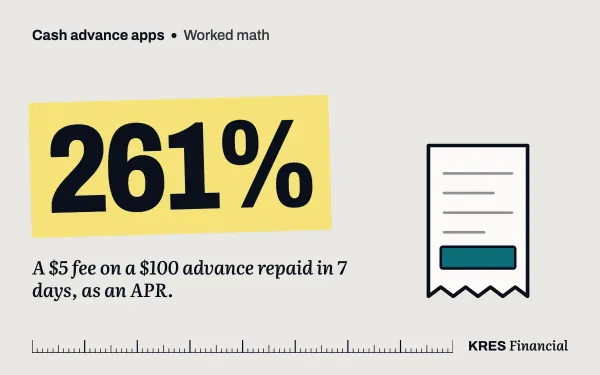
To compare a cash advance fee with other ways to borrow, divide the fee by the amount advanced, then multiply by 365 and divide by the number of days until repayment. By that math, a $5 fee on a $100 advance repaid in 7 days is about 261% APR; the CFPB calculated about 110% for a typical employer-based advance and almost 400% for a typical two-week payday loan.
Key takeaways
- To compare a cash advance fee with other ways to borrow, divide the fee by the amount advanced, then multiply by 365 and divide by the number of days until repayment.
- By that math, a $5 fee on a $100 advance repaid in 7 days is about 261% APR; the CFPB calculated about 110% for a typical employer-based advance and almost 400% for a typical two-week payday loan.
On this page
Research method: Desk research. We read published sources; we did not use or test a product.
An APR is not the only way to judge a cost, and for a single small advance, the dollar amount may matter more to you. But it is the one number that lets an advance, a payday loan, a credit card, and an overdraft sit side by side.
A note on conflicts: the editor's past work includes growth marketing for a consumer finance company that offers cash advances. No company is named or priced on this page. See About.
The formula
APR = (fee ÷ amount advanced) × (365 ÷ days until repayment) × 100
This simple method reproduces the illustrative figures in the Consumer Financial Protection Bureau's (CFPB) 2024 data report exactly. [1] Count every charge you paid to get that advance: a faster-delivery fee, a tip, and the share of any monthly membership that month.
Why this is worth doing yourself: many of these products do not show an APR. In December 2025, the CFPB said that for employer-based "Covered EWA," optional faster-delivery fees and tips are not, "in the normal course, finance charges" under the federal Truth in Lending rules [3], the rules that require lenders to disclose an APR on loans. [5]
The CFPB's own examples
Scroll sideways to read all columns if the table is wider than your screen.
| Example (from the CFPB) | Amount | Fees | Days | APR |
|---|---|---|---|---|
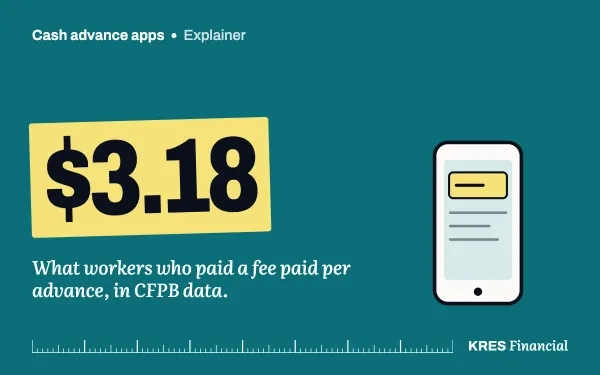
| Typical employer-based advance | $106 | $3.18 | 10 | 109.5% |
| Direct-to-consumer example (fee plus average tip) | $144 | $8 | 7 | 290% |
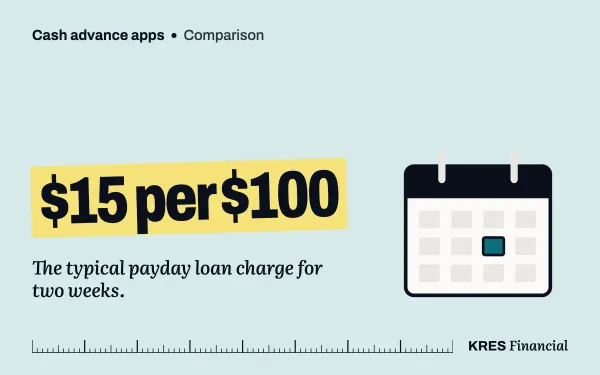
| Typical two-week payday loan ($15 per $100) | $100 | $15 | 14 | almost 400% |
| Small, short employer-based advance | $50 | $3.18 | 4 | 580.4% |
Sorted by APR, lowest first. Sources: advance examples [1]; payday example [2]. Our formula reproduces each figure (the payday example works out to 391%, which the CFPB rounds to "almost 400 percent").
Notice the last row. The same $3.18 fee is 109.5% on a larger, longer advance and 580.4% on a smaller, shorter one. The CFPB made this point itself: the typical figure "understates APRs for smaller transactions with shorter terms." [1]
Worked examples with common fee shapes
These rows are illustrations of the math with round numbers, not prices from any particular app.
Scroll sideways to read all columns if the table is wider than your screen.
| Scenario | Amount | Cost | Days | APR (our arithmetic) |
|---|---|---|---|---|
| Free standard delivery, no tip | $100 | $0 | 3 | 0% |
| $1 monthly membership, one advance that month | $100 | $1 | 14 | 26.1% |
| $5 faster-delivery fee | $100 | $5 | 14 | 130.4% |
| $9.99 monthly membership, one advance that month | $100 | $9.99 | 14 | 260.5% |
| $5 faster-delivery fee | $100 | $5 | 7 | 260.7% |
| $3 fee on a small advance | $50 | $3 | 7 | 312.9% |
Sorted by APR, lowest first.
Three patterns stand out:
- The free option changes everything. In the CFPB's sample, 96.6% of fees workers paid were for faster delivery. [1] Waiting a day or two for a free transfer is the single biggest lever on cost.
- A membership is a cost even in months with no advance. In a month with no advance, the APR math does not apply, but the dollars still leave your account.
- Shorter is not cheaper. A fee repaid sooner produces a higher APR, because the same dollars buy fewer days.
The yearly view
For someone using advances regularly, a per-advance APR can be less useful than a yearly total. The CFPB found that "the average worker in our sample had 27 earned wage transactions per year" and that "workers paid an average of $68.88 per year in fees." [1]
To estimate your own: (fees per advance × advances per year) + (monthly membership × 12). For example, by our arithmetic, a $5 fee 24 times a year is $120, and a $9.99 membership is $119.88 a year before any fees.
How the alternatives compare, in dollars
The dollar cost of a single small shortfall, using CFPB figures:
Scroll sideways to read all columns if the table is wider than your screen.
| Option | Typical cost | Source |
|---|---|---|
| Advance with free standard delivery | $0 | [1] |
| Employer-based advance, when a fee is paid | about $3.18 | [1] |
| Payday loan, $100 for two weeks at $15 per $100 | $15 | [2] |
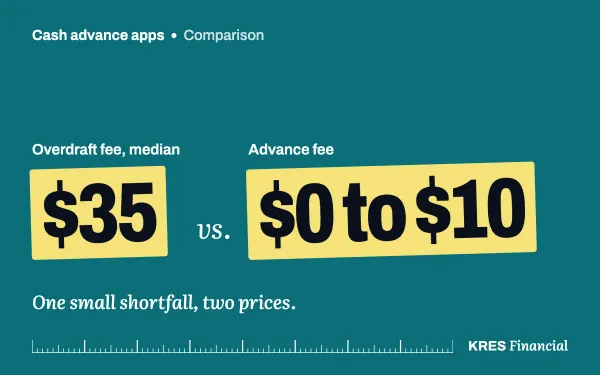
| Bank overdraft fee at a large bank or credit union | median $35 | [4] |
Sorted by cost, lowest first. The overdraft figure is the CFPB's estimate of the median fee at the 119 banks and credit unions with more than $10 billion in assets that charged overdraft fees, from market monitoring between December 2022 and August 2023. [4] Fees at your own bank may differ.
The comparison is narrower than it looks: an advance that is repaid by debiting an account that is short on payday can cause an overdraft fee too. See repayment and overdraft risk.
Reading the worked examples
The worked examples above show how the amount, fees, and days until repayment affect the dollar cost and annualized rate. Use the formula above to compare your own figures. Data date: November 11, 2026.
Who this fits
- Anyone weighing an advance fee against a payday loan, a credit card, or an overdraft.
- Anyone already using an app who wants to see the yearly total.
Who should skip this
- Anyone who can wait for free delivery. The fee is the largest cost in the CFPB's data, and without it most of this math goes to zero. [1]
- Anyone deciding on a single, one-time advance where the dollar figure is clearly small. The APR is a comparison tool; it is not the whole story.
Related reading
Sources
- Data Spotlight: Developments in the Paycheck Advance Market (July 2024). Consumer Financial Protection Bureau. Read November 11, 2026.
- What is a payday loan?. Consumer Financial Protection Bureau. Read November 11, 2026.
- Truth in Lending (Regulation Z); Non-application to Earned Wage Access Products, advisory opinion (December 2025). Consumer Financial Protection Bureau. Read November 11, 2026.
- Overdraft and Nonsufficient Fund Fees (December 2023). Consumer Financial Protection Bureau. Read November 11, 2026.
- 12 CFR 1026.18, Content of disclosures (Regulation Z). Electronic Code of Federal Regulations. Read November 11, 2026.
Change log
- : First version, with worked examples and source checks.
Educational information only. Not financial, insurance, legal, or tax advice. Read our editorial policy.
Related guides
Cash Advance App vs. Payday Loan: Costs, Repayment, and Risks
Both cover a gap until payday and both get repaid from your next paycheck. How the costs compare, using CFPB figures, and when each is worth skipping.
How Cash Advance Apps Work, and What They Actually Cost
How paycheck advance apps decide eligibility, collect repayment, and charge fees. Start with the costs, timing, and reasons to skip an advance.
Overdraft vs. a Cash Advance App: Which Costs Less for a Short Gap?
A $35 overdraft fee against a $0 to $10 advance fee, the rules for each, and the case where an advance causes an overdraft anyway. CFPB data, dated.