Can a Cash Advance App Overdraft Your Account? How Repayment Works
Yes. Apps that debit your account on payday can push it below zero and trigger bank fees. Why it happens, what the rules say, and how to stop a debit.
How we are paidThis page has no paid links. Kres Financial may earn commissions on other pages when a reader uses a paid link. How we make money.
The short answer
Yes. Most direct-to-consumer cash advance apps collect repayment by debiting your bank account, and if the money is not there, the CFPB says this 'could result in consumers paying overdraft or NSF fees.' Declining your bank's overdraft coverage only protects ATM and one-time debit card transactions, so it may not stop a fee on an app's electronic withdrawal.
On this page
Research method: Desk research. We read published sources; we did not use or test a product.
Yes. Most direct-to-consumer cash advance apps collect repayment by debiting your bank account, and if the money is not there, the CFPB says this "could result in consumers paying overdraft or NSF fees." Declining your bank's overdraft coverage only protects ATM and one-time debit card transactions, so it may not stop a fee on an app's electronic withdrawal.
This is the risk that can turn an advance with a $3 fee into a $38 problem. Here is how it happens and what the rules let you do about it.
A note on conflicts: the editor's past work includes growth marketing for a consumer finance company that offers cash advances. No company is named on this page or pays Kres Financial. See About.
Why it happens
The Consumer Financial Protection Bureau (CFPB) describes the setup: direct-to-consumer apps do not have access to your employer's payroll, so "repayment is typically made by directly debiting the consumer's bank account, which could result in consumers paying overdraft or NSF fees if their accounts do not contain sufficient funds on the repayment date." [1]
Common ways the money is not there on the day:
- The paycheck lands later than the app expected (a holiday, a new job, a short week).
- Another automatic bill hits the same morning.
- A second app is collecting on the same payday. The CFPB flagged the risk that workers "could use multiple direct-to-consumer products." [1]
Employer-based programs, by contrast, are "repaid by payroll deduction" and "typically have no access to the worker's bank account for repayment." [1] The overdraft risk described here is mainly a direct-to-consumer problem.
What a shortfall can cost
When an electronic withdrawal hits an account without enough money, the bank generally either pays it and charges an overdraft fee, or returns it and may charge a nonsufficient funds (NSF) fee. The CFPB says an NSF fee "is often the same amount as an overdraft fee," and that "declined payments may trigger a returned item fee from the merchant." [2]
How big? From market monitoring between December 2022 and August 2023, the CFPB estimated the median overdraft fee at $35 at the 119 large banks and credit unions (over $10 billion in assets) that charged one, and the median NSF fee at $32 at the 53 still charging NSF fees. [4] Smaller banks, and banks that have dropped these fees, may charge less or nothing; the account's fee schedule says.
Compare that with the advance itself: the CFPB's data put the average fee, when one was paid, at about $3.18. [1] One overdraft can cost about ten times the advance fee.
Why "opting out of overdraft" may not protect you here
Federal rules (Regulation E) say a bank cannot charge an overdraft fee "for paying an ATM or one-time debit card transaction" unless you opted in. [3] The CFPB's plain-language version: "For one-time debit card transactions and ATM withdrawals, banks cannot charge you an overdraft fee unless you opt in. However, banks are allowed to charge overdraft fees for checks and recurring electronic payments, even if you did not opt in." [2]
The rule's official interpretation is explicit that a negative balance caused by "a check, ACH, or other type of transaction not subject to the prohibition" can still carry fees. [3] An app that collects by pulling from your account number (an ACH debit) falls outside the opt-in protection. An app that collects by charging your debit card may be treated as a one-time debit card transaction. How the app collects, which its terms describe, decides which rule applies.
You can still change your overdraft choice at any time. The CFPB says: "Just notify them that you no longer want this coverage." [2]
How to stop or move a debit
If a repayment is coming and the money will not be there, there are three tools, and they do different things.
1. Ask the app to move the date. Whether an app allows a date change is in its terms or support pages. Where it is allowed, it is the least disruptive option.
2. Revoke the company's permission to debit your account. The CFPB says you have "the right to stop a company from taking automatic payments from your account, even if you previously allowed them." [5] The steps: tell the company, then tell your bank. After both, "any additional payments initiated by that company would be errors, and you can contact your bank for a refund." [5] Under Regulation E's official interpretation, once a bank is told an authorization is no longer valid, it "must block all future payments for the particular debit," and "may not wait for the payee-originator to terminate the automatic debits." [6] A bank may ask for written confirmation within 14 days of a phone request. [6]
3. Place a stop-payment order with your bank. A bank "must honor an oral stop-payment order made at least three business days before a scheduled debit." [6] The CFPB notes that "banks and credit unions generally charge fees for stop payment orders." [5]
What none of these do: cancel what you owe. The CFPB is clear that "if you cancel an automatic payment on a loan, you still have to make payments on the loan using another payment method." [5] Stopping a debit buys time to pay another way; it does not end the obligation, and the app's own terms describe what happens next.
If a debit goes through anyway
If a payment is taken after you revoked permission, or one you never authorized, the CFPB says to tell your bank right away: "Federal law gives you the right to dispute and get your money back for unauthorized transfers from your account, as long as you tell your bank in time." [5] Keeping dates of every request (to the app and to the bank) makes this easier.
Who this fits
- Anyone with an advance outstanding who is not sure the money will be there on payday.
- Anyone who has been hit with an overdraft fee after an app's repayment.
Who should skip this
- Anyone with an unpredictable pay date. The repayment date is the risky part of any advance, and this risk is built into how direct-to-consumer apps collect. [1]
- Anyone already carrying an advance from another app. Two debits on the same payday raise the odds of a shortfall. [1]
Related reading
Sources
- Data Spotlight: Developments in the Paycheck Advance Market (July 2024). Consumer Financial Protection Bureau. Read November 11, 2026.
- What can I do if my bank charged me a fee for overdrawing my account?. Consumer Financial Protection Bureau. Read November 11, 2026.
- 12 CFR 1005.17, Requirements for overdraft services (Regulation E), with official interpretation. Consumer Financial Protection Bureau. Read November 11, 2026.
- Overdraft and Nonsufficient Fund Fees (December 2023). Consumer Financial Protection Bureau. Read November 11, 2026.
- How do I stop automatic payments from my bank account?. Consumer Financial Protection Bureau. Read November 11, 2026.
- 12 CFR 1005.10, Preauthorized transfers (Regulation E), with official interpretation. Consumer Financial Protection Bureau. Read November 11, 2026.
Change log
- : First version. Facts checked against the sources listed.
Educational information only. Not financial, insurance, legal, or tax advice. Read our editorial policy.
Related guides
Cash Advance App vs. Payday Loan: Costs, Repayment, and Risks
Both cover a gap until payday and both get repaid from your next paycheck. How the costs compare, using CFPB figures, and when each is worth skipping.
How Cash Advance Apps Work, and What They Actually Cost
How paycheck advance apps decide eligibility, collect repayment, and charge fees. Start with the costs, timing, and reasons to skip an advance.
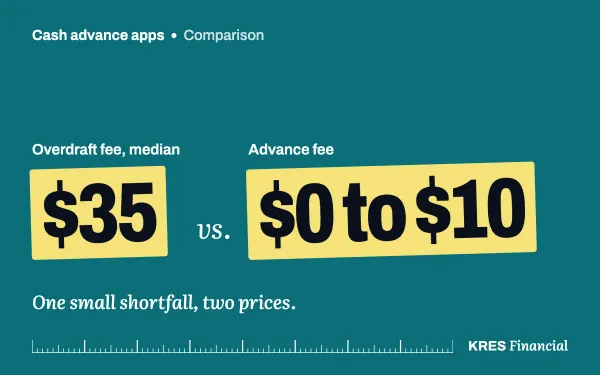
Overdraft vs. a Cash Advance App: Which Costs Less for a Short Gap?
A $35 overdraft fee against a $0 to $10 advance fee, the rules for each, and the case where an advance causes an overdraft anyway. CFPB data, dated.