How Cash Advance Apps Work, and What They Actually Cost
How paycheck advance apps decide eligibility, collect repayment, and charge fees. Start with the costs, timing, and reasons to skip an advance.
How we are paidThis page has no paid links. Kres Financial may earn commissions on other pages when a reader uses a paid link. How we make money.
The short answer
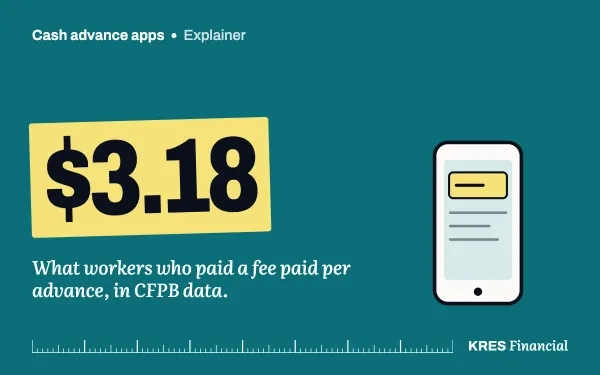
A cash advance app gives you a small amount of money before payday and takes it back, usually by debiting your bank account when your pay arrives. Many advertise no interest, but the costs come as monthly memberships, fees for instant delivery, and suggested 'tips'; in CFPB data, workers who paid a fee paid about $3.18 per advance, which works out to an illustrative APR of about 110% on a typical advance.
Key takeaways
- A cash advance app gives you a small amount of money before payday and takes it back, usually by debiting your bank account when your pay arrives.
On this page
Research method: Desk research. We read published sources; we did not use or test a product.
A cash advance app gives you a small amount of money before payday and takes it back, usually by debiting your bank account when your pay arrives. Many advertise no interest, but the costs come as monthly memberships, fees for instant delivery, and suggested "tips"; in CFPB data, workers who paid a fee paid about $3.18 per advance, which works out to an illustrative APR of about 110% on a typical advance.
This is the starting page for our cash gaps section. It explains the mechanics, the costs, and the risks in order, and links to the pages that go deeper.
A note on conflicts: the editor's past work includes growth marketing for a consumer finance company that offers cash advances. No company named or described on this page pays Kres Financial. See About.
Two kinds of products that get called the same thing
The Consumer Financial Protection Bureau (CFPB) separates these products into two models: [1]
- Employer-partnered. A company works with your employer, checks "the employer's time and attendance records to determine actual wages that have been earned but not yet paid," and "is repaid by payroll deduction." These firms "do not pull credit reports or credit scores, and typically have no access to the worker's bank account for repayment."
- Direct-to-consumer. An app you sign up for yourself, with no employer involved. Because these firms usually cannot see payroll records, they "typically require proof of or access to recent pay stubs or regular bank deposits and bank account transactions." Repayment "is typically made by directly debiting the consumer's bank account."
Apps marketed directly to the public, with no employer involved, are the second kind. The difference matters, because it changes how you repay and what can go wrong.
How much you can get
Apps set your amount from their read of your income and bank activity, and the advertised maximum is not what most people get.
In the CFPB's data from employer-partnered providers, "the average transaction amount ranged from $35 to $200, with an overall average transaction size of $106." [1]
On the direct-to-consumer side, the Federal Trade Commission sued one large app in November 2024, alleging that its advertising was "dominated by claims that consumers can receive 'up to $500'" while the company "offered advances of $500 only a tiny percentage of the time." [3] Those are the FTC's allegations, not findings by a court. They show why "up to" is the number to discount most.
Where the costs come from
The costs usually come in three forms: [1]
Scroll sideways to read all columns if the table is wider than your screen.
| Cost | How it works | What the data shows |
|---|---|---|
| Fee for instant delivery | Free transfers can take one to three days; paying a fee gets the money in minutes | In the CFPB's employer-partnered sample, 96.6% of fees workers paid were for faster delivery [1] |
| Monthly membership | A subscription, charged whether or not you take an advance that month | "Far more common in the direct-to-consumer space" than in employer-partnered products [1] |
| "Tips" | A suggested amount, sometimes preset | One data summary cited by the CFPB found an average tip of $4.09, paid 73% of the time at tip-based providers [1] |
Faster-delivery fees, listed first, were by far the largest category in the CFPB's sample; tips were not part of that sample. The FTC's November 2024 complaint gives a sense of the ranges at one app: it alleged an "Express Fee" ranging "from $3 to $25," a "surprise fee of 15% of their advance that's described ... as a 'tip,'" and a "$1 monthly 'membership fee' debited directly from consumers' bank accounts." [3]
What that adds up to
The CFPB's numbers, from employer-partnered providers in 2021 and 2022: [1]
- "Roughly 90% of workers paid at least one" fee.
- "When workers paid a fee, the average size was approximately $3.18."
- "The average worker in our sample had 27 earned wage transactions per year."
- "Workers paid an average of $68.88 per year in fees."
As an annual percentage rate, the CFPB calculated that "a single earned wage product transaction of $106 with $3.18 in fees for a ten-day period ... equates to an APR of 109.5%," and that "a $50 transaction with $3.18 in fees for four days equates to a 580.4% APR." [1] For a direct-to-consumer example, the bureau calculated that "a $144 transaction for a seven-day period, with $8 in fees (the combined average tip and fee amount) equates to a 290% APR." [1]
Those figures are for comparison. A $3 fee is small in dollars; it is large relative to a small amount borrowed for a few days. Our cost breakdown shows how to do this math for any offer.
How repayment works, and the overdraft risk
Direct-to-consumer apps usually take repayment straight from your bank account on or around payday. The CFPB notes this "could result in consumers paying overdraft or NSF fees if their accounts do not contain sufficient funds on the repayment date." [1] An app's fee plus a bank's overdraft fee can turn a $3 cost into a much larger one. Details and ways to manage it: repayment and overdraft risk.
You can stop a company from debiting your account. The CFPB says you have "the right to stop a company from taking automatic payments from your account, even if you previously allowed them," but also that this does not erase what you owe: "If you cancel an automatic payment on a loan, you still have to make payments on the loan using another payment method." [4]
Are these loans?
The legal answer is unsettled, and this page does not try to settle it. In December 2025, the CFPB issued an advisory opinion saying that one kind of product, employer-based "Covered EWA" that is limited to wages already earned and repaid through payroll, is not credit under the federal Truth in Lending rules. The same opinion said it "does not state, and nothing in it should be understood to state, that EWA products that are not Covered EWA are credit," and that it does not interpret laws outside those rules. [2] States can have their own rules. What matters for a reader is the cost, which this page describes either way.
Credit reports
An advance is not a credit-building product unless the app says it reports repayments to the credit bureaus. For a similar short-term product, payday loans, the CFPB notes payments are not reported to the nationwide bureaus "even if you make on-time payments." [5] If building credit is the goal, see our credit building section.
Who this fits
- Someone with a one-time, small gap of a few days, a steady deposit, and enough in the account on payday to cover the repayment.
- Someone who can wait for the free delivery option, which removes the largest fee category in the CFPB's data. [1]
Who should skip this
- Anyone whose account is near zero on payday. The automatic repayment can trigger bank fees on top of the app's. [1]
- Anyone using it every pay period. Fees repeat; the CFPB's average worker made 27 transactions a year and paid $68.88 in fees. [1]
- Anyone with a free option. An employer-paid program, a bill that can be moved a few days, or a payment plan with the biller can cost less than any app.
Related reading
Sources
- Data Spotlight: Developments in the Paycheck Advance Market (July 2024). Consumer Financial Protection Bureau. Read November 11, 2026.
- Truth in Lending (Regulation Z); Non-application to Earned Wage Access Products, advisory opinion (December 2025). Consumer Financial Protection Bureau. Read November 11, 2026.
- FTC Takes Action Against Online Cash Advance App Dave for Deceiving Consumers, Charging Undisclosed Fees (November 5, 2024). Federal Trade Commission. Read November 11, 2026.
- How do I stop automatic payments from my bank account?. Consumer Financial Protection Bureau. Read November 11, 2026.
- What are some ways to start or rebuild a good credit history?. Consumer Financial Protection Bureau. Read November 11, 2026.
Change log
- : First version. Facts checked against the sources listed.
Educational information only. Not financial, insurance, legal, or tax advice. Read our editorial policy.
Related guides
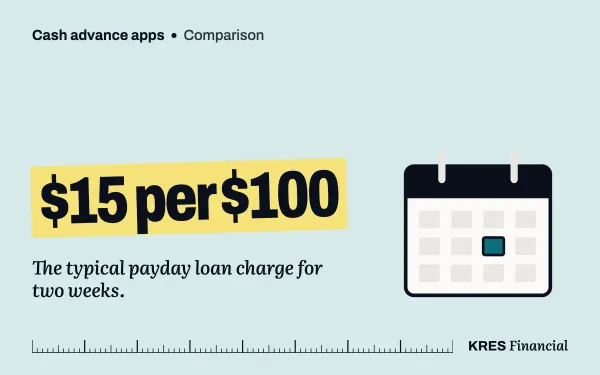
Cash Advance App vs. Payday Loan: Costs, Repayment, and Risks
Both cover a gap until payday and both get repaid from your next paycheck. How the costs compare, using CFPB figures, and when each is worth skipping.
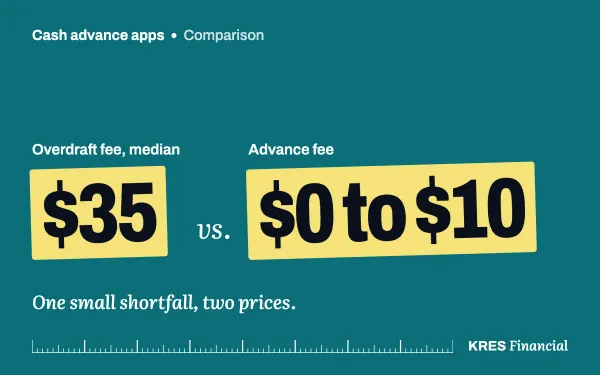
Overdraft vs. a Cash Advance App: Which Costs Less for a Short Gap?
A $35 overdraft fee against a $0 to $10 advance fee, the rules for each, and the case where an advance causes an overdraft anyway. CFPB data, dated.
Can a Cash Advance App Overdraft Your Account? How Repayment Works
Yes. Apps that debit your account on payday can push it below zero and trigger bank fees. Why it happens, what the rules say, and how to stop a debit.