Overdraft vs. a Cash Advance App: Which Costs Less for a Short Gap?
A $35 overdraft fee against a $0 to $10 advance fee, the rules for each, and the case where an advance causes an overdraft anyway. CFPB data, dated.
How we are paidThis page has no paid links. Kres Financial may earn commissions on other pages when a reader uses a paid link. How we make money.
The short answer
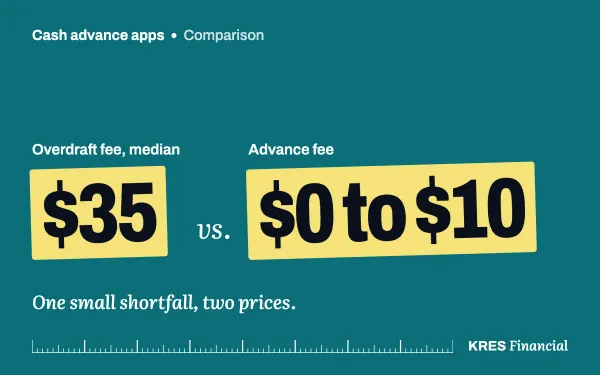
For a single small shortfall, a cash advance with a small or no fee usually costs less in dollars than a bank overdraft, which the CFPB found had a median fee of $35 at large banks. The advance only stays cheaper if your account can cover the repayment on payday; if it cannot, you can end up paying the advance fee and an overdraft fee.
Key takeaways
- For a single small shortfall, a cash advance with a small or no fee usually costs less in dollars than a bank overdraft, which the CFPB found had a median fee of $35 at large banks.
- The advance only stays cheaper if your account can cover the repayment on payday; if it cannot, you can end up paying the advance fee and an overdraft fee.
On this page
Research method: Desk research. We read published sources; we did not use or test a product.
Table order: total stated cost, lowest first. Compensation does not determine order.
Below, the same shortfall runs through each option, with the rules that decide which fees can apply.
A note on conflicts: the editor's past work includes growth marketing for a consumer finance company that offers cash advances. No company is named in this comparison or pays Kres Financial. See About.
The two options in plain terms
Overdraft. Your bank pays a transaction your balance cannot cover, and charges a fee. The CFPB's definition: "An overdraft occurs when you don't have enough money in your account to cover a transaction, and if you're opted into an overdraft protection program, your bank would pay for the transaction but charge you a fee." [2]
Cash advance app. An app sends you money before payday and takes it back from your account, usually on payday. The costs, if any, are faster-delivery fees, memberships, and tips. [4]
One $100 shortfall, one week
Table order: total stated cost, lowest first. Compensation does not determine order.
Scroll sideways to read all columns if the table is wider than your screen.
| Option | Cost in dollars | APR equivalent (our arithmetic) | Source |
|---|---|---|---|
| Advance, free standard delivery, no tip | $0 | 0% | [4] |
| Advance, typical fee when one is paid | about $3.18 | about 166% | [4] |
| Advance, $5 faster-delivery fee | $5 | about 261% | illustration |
| Overdraft at the median large-bank fee | $35 | about 1,825% | [1] |
| Advance that overdraws your account on payday | about $3.18 plus $35 | n/a | [1] [4] |
Sorted by cost, lowest first. The advance fee is the CFPB's average fee when a fee was paid, from its 2021 and 2022 data. The $35 is the CFPB's estimate of the median overdraft fee at the 119 banks and credit unions with over $10 billion in assets that charged one, from monitoring between December 2022 and August 2023. [1] APRs use the formula fee ÷ amount × 365 ÷ days, for 7 days. The $5 row is a round-number illustration, not a specific app's price.
Two cautions on the table. Your bank's fee may be lower, or zero; some institutions have reduced or dropped these fees, and the Congressional Research Service reports that from 2020 to 2023, banks "reduced their revenue from overdraft and non-sufficient fund (NSF) fees by nearly 50%." [5] And an app's actual fees can be higher than the average: the FTC alleged in a November 2024 complaint against one app that its "Express Fee" ranged "from $3 to $25." [6] Those are the FTC's allegations, not court findings.
The rules that decide which fees apply
For debit card purchases and ATM withdrawals, overdraft fees require your opt-in. Under Regulation E, a bank cannot charge a fee "for paying an ATM or one-time debit card transaction" through its overdraft service unless you opted in. [3] Without the opt-in, the bank cannot charge an overdraft fee on them. [2]
For checks and electronic payments, no opt-in is required. The CFPB says "banks are allowed to charge overdraft fees for checks and recurring electronic payments, even if you did not opt in." [2] If the bank returns the payment unpaid, it may charge an NSF fee, which "is often the same amount as an overdraft fee," and the merchant may add "a returned item fee." [2]
You can change your choice. "If you are enrolled in an overdraft protection program with your bank or credit union, you can change your mind at any time." [2]
A federal fee cap was proposed and then overturned. The CFPB finalized a rule in December 2024 that would have capped overdraft fees at large banks at $5 or required other options. Congress overturned it under the Congressional Review Act; the resolution, S.J.Res. 18, was signed into law as Public Law 119-10. [5] So there is no federal cap on overdraft fees today.
Why the advance can backfire
The lowest-cost row in the table depends on payday going well. The CFPB notes that direct-to-consumer apps collect "by directly debiting the consumer's bank account, which could result in consumers paying overdraft or NSF fees if their accounts do not contain sufficient funds on the repayment date." [4] That debit is an electronic payment, so the opt-in protection for debit card purchases may not apply to it. [2] [3]
In that case, the advance did not replace the overdraft. It moved it a week later and added a fee. More: repayment and overdraft risk.
Who repeats overdrafts
The Congressional Research Service, citing CFPB data, reports that "roughly 9% of accounts comprise 79% of overdraft and insufficient funds fees, and these consumers overdraft more than 10 times a year." [5] For someone in that group, the comparison is less about one shortfall and more about the yearly total of whichever option becomes the habit. Our cost page shows how to add it up.
Who each fits
An advance tends to fit a one-time shortfall, with a reliable deposit and enough left after payday to cover the repayment, especially if the free delivery option is fast enough.
Overdraft coverage tends to fit someone at a bank that charges low or no overdraft fees, as its fee schedule shows, or someone who would rather have an important payment go through than be declined.
Neither tends to fit a gap that will still be there next payday.
Who should skip this
- Skip the advance if payday will not cover the repayment. The overdraft you were avoiding can arrive a week later, with the advance fee on top. [4]
- Skip both if the bill can move. Asking a biller for a new due date or a payment plan can cost nothing.
- Skip relying on overdraft coverage if your bank's fee schedule is high. At the CFPB's $35 median, one overdraft costs about ten times the average advance fee. [1] [4]
Related reading
Sources
- Overdraft and Nonsufficient Fund Fees (December 2023). Consumer Financial Protection Bureau. Read November 11, 2026.
- What can I do if my bank charged me a fee for overdrawing my account?. Consumer Financial Protection Bureau. Read November 11, 2026.
- 12 CFR 1005.17, Requirements for overdraft services (Regulation E), with official interpretation. Consumer Financial Protection Bureau. Read November 11, 2026.
- Data Spotlight: Developments in the Paycheck Advance Market (July 2024). Consumer Financial Protection Bureau. Read November 11, 2026.
- Overdraft Fees (Insight IN12513). Congressional Research Service. Read November 11, 2026.
- FTC Takes Action Against Online Cash Advance App Dave for Deceiving Consumers, Charging Undisclosed Fees (November 5, 2024). Federal Trade Commission. Read November 11, 2026.
Change log
- : First version. Facts checked against the sources listed.
Educational information only. Not financial, insurance, legal, or tax advice. Read our editorial policy.
Related guides
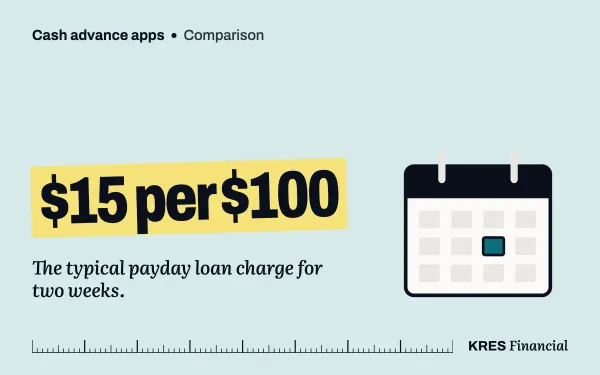
Cash Advance App vs. Payday Loan: Costs, Repayment, and Risks
Both cover a gap until payday and both get repaid from your next paycheck. How the costs compare, using CFPB figures, and when each is worth skipping.
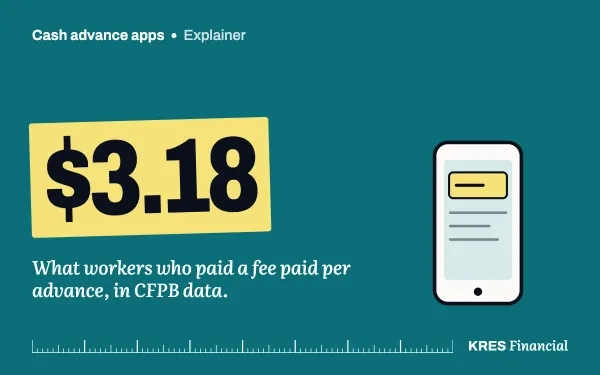
How Cash Advance Apps Work, and What They Actually Cost
How paycheck advance apps decide eligibility, collect repayment, and charge fees. Start with the costs, timing, and reasons to skip an advance.
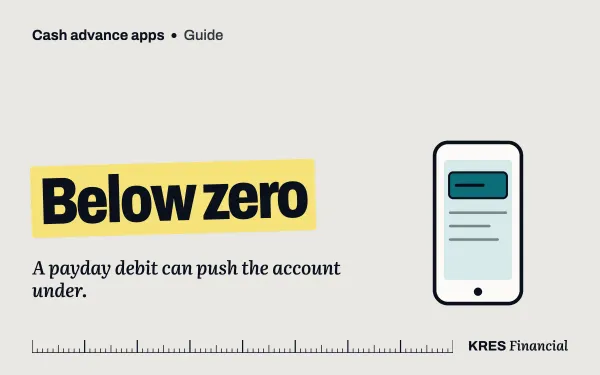
Can a Cash Advance App Overdraft Your Account? How Repayment Works
Yes. Apps that debit your account on payday can push it below zero and trigger bank fees. Why it happens, what the rules say, and how to stop a debit.