Cash Advance App vs. Payday Loan: Costs, Repayment, and Risks
Both cover a gap until payday and both get repaid from your next paycheck. How the costs compare, using CFPB figures, and when each is worth skipping.
How we are paidThis page has no paid links. Kres Financial may earn commissions on other pages when a reader uses a paid link. How we make money.
The short answer
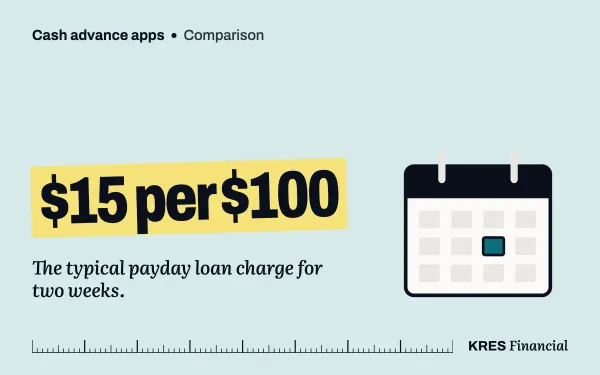
Both give you money before payday and take it back from your next paycheck, but they are priced differently: a payday loan typically charges $15 per $100 for two weeks, which the CFPB says equals an APR of almost 400%, while a cash advance app's cost depends on whether you pay for faster delivery, a membership, or a tip. Both can lead to bank fees if repayment bounces.
Key takeaways
- Both can lead to bank fees if repayment bounces.
On this page
Research method: Desk research. We read published sources; we did not use or test a product.
Table order: total stated cost, lowest first. Compensation does not determine order.
A note on conflicts: the editor's past work includes growth marketing for a consumer finance company that offers cash advances. No company is named in this comparison or pays Kres Financial. See About.
Side by side
Table order: total stated cost, lowest first. Compensation does not determine order.
Scroll sideways to read all columns if the table is wider than your screen.
| Payday loan | Cash advance app | |
|---|---|---|
| Typical amount | "Generally for $500 or less"; "a common loan limit is $500" [1] | Average of $106 in the CFPB's employer-partnered data [2] |
| When it is due | Usually "a single payment on the borrower's next payday," typically "two to four weeks from the date the loan was made" [1] | Next payday, by payroll deduction (employer-based) or a debit from your account (direct-to-consumer) [2] |
| How you are charged | A fee per amount borrowed; state limits range "from $10 to $30 for every $100 borrowed" [1] | Faster-delivery fees, memberships, or tips; most employer-based providers offer a free option [2] |
| How you repay | A "post-dated check" or authorization "to electronically debit the funds" [1] | Payroll deduction or an account debit [2] |
| Ability-to-repay check | "Payday lenders do not generally verify your ability to repay" [1] | Employer-based firms "do not pull credit reports or credit scores"; direct-to-consumer apps estimate income from bank activity or pay stubs [2] |
| Builds credit? | No: payments are not reported "even if you make on-time payments" [3] | Not a credit-building product unless the app says it reports to the bureaus |
| Where it is allowed | Set by state law; some states do not have payday lending [1] | Federal treatment is unsettled outside one employer-based category; states can have their own rules [4] |
The cost, in the same terms
Using the CFPB's own figures:
Table order: total stated cost, lowest first. Compensation does not determine order.
Scroll sideways to read all columns if the table is wider than your screen.
| Example | Amount | Cost | Days | APR | Source |
|---|---|---|---|---|---|
| Employer-based advance, free delivery | any | $0 | n/a | 0% | [2] |
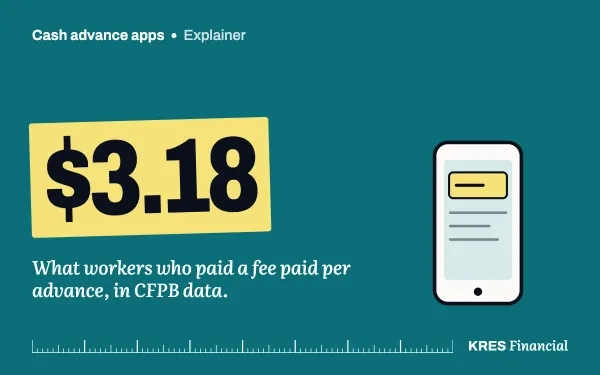
| Employer-based advance, typical fee | $106 | $3.18 | 10 | 109.5% | [2] |
| Direct-to-consumer advance, fee plus average tip | $144 | $8 | 7 | 290% | [2] |
| Payday loan at $15 per $100 | $100 | $15 | 14 | almost 400% | [1] |
Sorted by APR, lowest first. The APR figures are the CFPB's. For context, the CFPB notes that "APRs on credit cards can range from about 12 percent to about 30 percent." [1]
In dollars, the gap is wide for one use: $15 on a $100 payday loan, against $0 to roughly $8 on the advance examples. The gap narrows if an app's fees are at the high end. The FTC alleged in November 2024 that one app charged an "Express Fee" ranging "from $3 to $25" and a default "tip" of "15% of their advance." [6] Those are the FTC's allegations, not court findings.
The risks each one carries
Payday loans: rollovers. "Some state laws permit lenders to 'rollover' or 'renew' a loan when it becomes due so that you pay only the fees, and the lender extends the due date of the loan." [1] Each rollover is another fee with the same balance still owed.
Both: a repayment that bounces. A payday lender can "cash the check or electronically withdraw money from your account" on the due date. [1] A direct-to-consumer app debits the account too, which the CFPB says "could result in consumers paying overdraft or NSF fees." [2] See repayment and overdraft risk.
Both: repeat use. The CFPB found the average worker in its advance data made 27 transactions a year and paid $68.88 in fees. [2] A product used every pay period stops being a bridge and becomes a monthly cost.
You can revoke a company's permission to debit your account by telling both the company and your bank, but the CFPB notes that this does not cancel what you owe: "If you cancel an automatic payment on a loan, you still have to make payments on the loan using another payment method." [5]
Protections for servicemembers
"Active duty servicemembers and their dependents have protections on loans through the federal Military Lending Act (MLA)," the CFPB says, including "a cap of 36 percent on the Military Annual Percentage Rate (MAPR)." [1] The CFPB points servicemembers to their local Judge Advocate General's legal assistance office for help. [1]
Who each fits
A cash advance tends to fit a single, small gap of days, with a reliable deposit and enough in the account on payday, especially where the free delivery option is available. [2]
A payday loan rarely fits better on cost alone, given the CFPB's figures above. It may be the only option for someone a cash advance app will not approve, which is a reason to weigh the free alternatives below first.
Neither fits a gap that will repeat next payday.
Who should skip this
- Skip a payday loan where rollovers are allowed and one payment is uncertain. The fees repeat each time. [1]
- Skip either one if the gap will still be there next payday. Both are built for one short shortfall. [2]
- Servicemembers and dependents have Military Lending Act protections that change the math; checking them comes first. [1]
Free options are worth a look before either: a bill due date moved a few days, a payment plan with the biller, or an employer-paid early pay program.
Related reading
Sources
- What is a payday loan?. Consumer Financial Protection Bureau. Read November 11, 2026.
- Data Spotlight: Developments in the Paycheck Advance Market (July 2024). Consumer Financial Protection Bureau. Read November 11, 2026.
- What are some ways to start or rebuild a good credit history?. Consumer Financial Protection Bureau. Read November 11, 2026.
- Truth in Lending (Regulation Z); Non-application to Earned Wage Access Products, advisory opinion (December 2025). Consumer Financial Protection Bureau. Read November 11, 2026.
- How do I stop automatic payments from my bank account?. Consumer Financial Protection Bureau. Read November 11, 2026.
- FTC Takes Action Against Online Cash Advance App Dave for Deceiving Consumers, Charging Undisclosed Fees (November 5, 2024). Federal Trade Commission. Read November 11, 2026.
Change log
- : First version. Facts checked against the sources listed.
Educational information only. Not financial, insurance, legal, or tax advice. Read our editorial policy.
Related guides
How Cash Advance Apps Work, and What They Actually Cost
How paycheck advance apps decide eligibility, collect repayment, and charge fees. Start with the costs, timing, and reasons to skip an advance.
Overdraft vs. a Cash Advance App: Which Costs Less for a Short Gap?
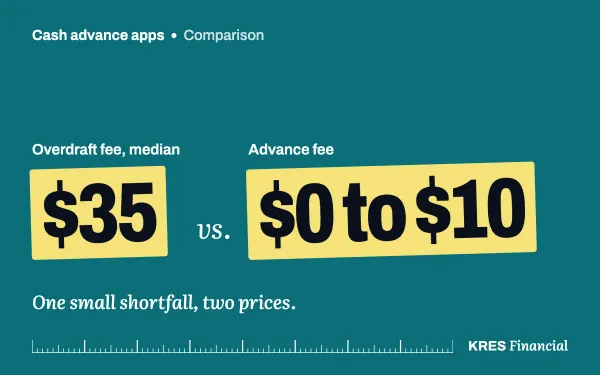
A $35 overdraft fee against a $0 to $10 advance fee, the rules for each, and the case where an advance causes an overdraft anyway. CFPB data, dated.
Can a Cash Advance App Overdraft Your Account? How Repayment Works
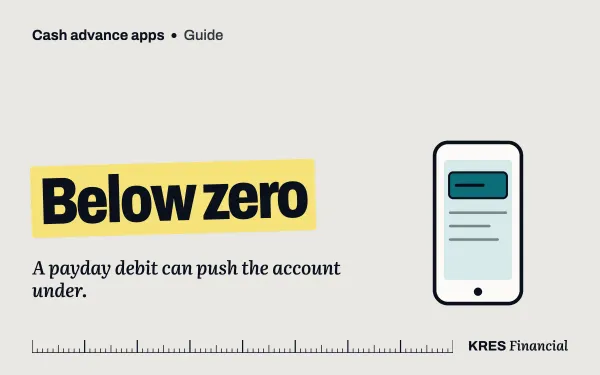
Yes. Apps that debit your account on payday can push it below zero and trigger bank fees. Why it happens, what the rules say, and how to stop a debit.