Credit Builder Loan vs. Secured Card: The Same Year, Both Ways
One year with a credit builder loan and one with a secured card, with real fees, locked money, and what a missed payment does. Sourced and dated.
How we are paidThis page has no paid links. Kres Financial may earn commissions on other pages when a reader uses a paid link. How we make money.
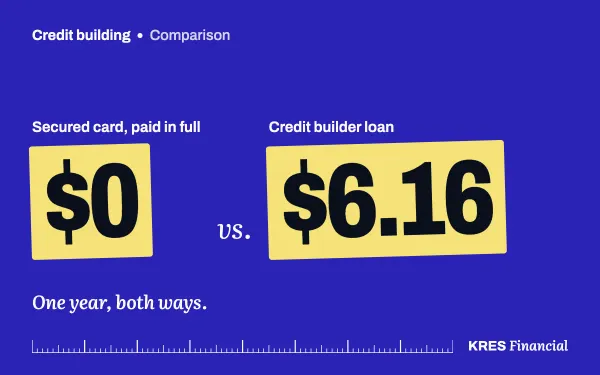
The short answer
Both report your payments to the credit bureaus, but they cost money in different ways. A secured card used for one small bill and paid in full each month can cost $0 in interest, with your deposit locked while the account is open; a credit builder loan costs interest or fees and locks the money you pay in until the last payment.
Key takeaways
- A secured card is the cheaper of the two only if the balance is paid in full.
- A credit builder loan has a small, known cost, and it forces you to save.
- The locked money is different in each product.
On this page
Research method: Desk research. We read published sources; we did not use or test a product.
Table order: total stated cost, lowest first. Compensation does not determine order.
The rest of this page runs one year through each product with published prices, so the tradeoff is in dollars instead of adjectives.
The two products in one paragraph each
Secured credit card. You put down a cash deposit, and you can spend up to roughly that amount. The CFPB's example: "You put in an amount of cash, for example $500. Then, you can spend up to that amount on your credit card." [1] It is a real credit card, with a monthly bill, an interest rate on any balance you carry, and reporting to the credit bureaus.
Credit builder loan. A lender sets a sum aside in a locked account. You pay it off in fixed monthly payments, "usually over six to 24 months," and "at the end of that time, you receive the full amount you paid." [1] Nothing is available to spend until the end.
One year, both ways
The examples below use products whose terms were published on November 11, 2026. They are examples of real pricing, not recommendations, and other lenders charge more or less.
Table order: total stated cost, lowest first. Compensation does not determine order.
Scroll sideways to read all columns if the table is wider than your screen.
| Scenario (12 months) | What you pay each month | Money locked up | Cost after 12 months | What you have at the end |
|---|---|---|---|---|
| Secured card, $200 deposit, one $25 bill a month, paid in full | $25 (the bill you already pay) | $200 deposit | $0 in fees or interest | Your $200 deposit, still held while the card is open |
| Credit builder loan, $500 at 2.25% APR (PNCU) | $42.18 | Everything you pay in, until the last payment | $6.16 | $500 |
| Credit builder loan, $500 at 4.00% APR (Secured Advantage FCU) | about $42.57 | Everything you pay in, until the last payment | about $10.84 | $500 |
| Secured card, $200 deposit, carrying a $200 balance all year | At least the minimum payment, plus new purchases | $200 deposit | Roughly $58 in interest | Your deposit, still held, plus whatever balance remains |
Sorted by total 12-month cost, lowest first. Sources: card terms [4]; loan terms [2] [3]. The PNCU payment is the credit union's own figure. The Secured Advantage payment, both loan costs, and the card interest are our arithmetic: the loan figures assume a standard fixed-payment loan at the stated APR, and the card figure is a simple estimate of 29.24% on a steady $200 balance. A card issuer's actual daily-balance method will give a somewhat different number.
The card terms used: a "$0 annual fee," a "$49, $99 or $200 minimum refundable deposit," and a "29.24% variable APR." [4] The deposit, the issuer says, is refunded if you are upgraded to an unsecured card or "when you close your account and pay your balance in full." [4]
What the table shows
A secured card is the cheaper of the two only if the balance is paid in full. The $0 row depends on one habit: paying the statement balance by the due date every month. The CFPB says paying the balance in full each month "keeps your interest costs as low as possible." [6] Carry the balance, and the same card becomes the most expensive line in the table.
A credit builder loan has a small, known cost, and it forces you to save. At these credit union rates, a year of payment history costs between about $6 and $11. The catch is cash flow: about $42 a month leaves your checking account and cannot be touched until month 12.
The locked money is different in each product. The card locks a deposit once, up front. The loan locks every payment as you make it. For someone with $200 available today, the card's structure may be easier. For someone with no lump sum but a steady $42 a month, the loan's structure may be easier.
Fees on secured cards: the federal limit
Some secured cards charge an annual fee or other account fees. Federal rules cap them in the first year: the total fees a consumer is required to pay "during the first year after account opening must not exceed 25 percent of the credit limit in effect when the account is opened." [5] On a $200 credit line, that is $50 at most in required fees in year one. The cap does not cover interest you choose to incur by carrying a balance, or penalty fees, which have their own rules. [5]
How each one shows up on your credit
- Payment history is 35% of a FICO score, the largest factor. [7] Both products build it, and both report a late payment the same way they report an on-time one.
- Amounts owed is 30% of a FICO score. [7] A card has a credit limit, so the share of the limit you use counts. The CFPB says many experts recommend using less than 30% of your limit and that people with the highest scores often use less than 10%. [6] On a $200 limit, a $25 bill is 12.5% of the limit.
- Credit mix is 10%. [7] A card is revolving credit and a credit builder loan is an installment loan. Fair Isaac says "it's not necessary to have one of each." [7]
If you miss a payment
On either product, a late payment can be reported, and the CFPB says negative payment history can generally stay on a report "for up to seven years." [9] On a card, a missed payment can also mean a late fee and interest. On a credit builder loan, the CFPB's study found that 39% of borrowers made at least one late payment on the loan. [8] This is the biggest risk with both products, and it is why the least costly option is the one whose payment fits the budget with room to spare.
Who each fits
A secured card tends to fit someone who has a small deposit available, already pays one predictable bill (a phone plan or a streaming service), and can set up autopay for the full statement balance.
A credit builder loan tends to fit someone with no lump sum, a steady income, no other loans to juggle, and no need for the money for 6 to 24 months. The CFPB's study found the largest gains for participants with no existing debt. [8]
Who should skip this
- Skip the secured card if you know you will carry a balance. At a variable APR near 30%, interest outruns the small, fixed cost of a credit union credit builder loan.
- Skip the credit builder loan if you need the cash you would be paying in. The money is locked until the end.
- Skip both if the deposit or the payment would make another bill late. A new late payment is the outcome that sets credit back the most.
- Skip both if you already have an open card with on-time history. The main thing either product sells, a record of on-time payments, may already exist.
Related reading
Sources
- What are some ways to start or rebuild a good credit history?. Consumer Financial Protection Bureau. Read November 11, 2026.
- Credit Builder Loan rate page (APR effective January 13, 2026). PNCU (credit union). Read November 11, 2026.
- Secured Advantage Starter Loans. Secured Advantage Federal Credit Union. Read November 11, 2026.
- Platinum Secured Credit Card. Capital One. Read November 11, 2026.
- 12 CFR 1026.52, Limitations on fees (Regulation Z). Electronic Code of Federal Regulations. Read November 11, 2026.
- How do I get and keep a good credit score?. Consumer Financial Protection Bureau. Read November 11, 2026.
- What's in my FICO Scores?. myFICO (Fair Isaac Corporation). Read November 11, 2026.
- Targeting Credit Builder Loans: Insights from a Credit Builder Loan Evaluation (July 2020). Consumer Financial Protection Bureau. Read November 11, 2026.
- How long does information stay on my credit report?. Consumer Financial Protection Bureau. Read November 11, 2026.
Change log
- : First version. Facts checked against the sources listed.
Educational information only. Not financial, insurance, legal, or tax advice. Read our editorial policy.
Related guides
Are Credit Builder Loans Worth It? The Cost, and Who Gains
A year of a credit builder loan can cost under $11 or far more. Who the research says gains, who loses, and three cases where it is not worth it.
How to Build Credit Without a Credit Card: What Counts and What Doesn't
Rent reporting, credit builder loans, and authorized user status can help build credit. Compare costs, limits, and what does not count.
What a Credit Builder Loan Really Costs: The Math, Line by Line
How to turn any credit builder offer into one dollar figure: total of payments, fees, and locked money. With a worked table at real and sample rates.