What a Credit Builder Loan Really Costs: The Math, Line by Line
How to turn any credit builder offer into one dollar figure: total of payments, fees, and locked money. With a worked table at real and sample rates.
How we are paidThis page has no paid links. Kres Financial may earn commissions on other pages when a reader uses a paid link. How we make money.
The short answer
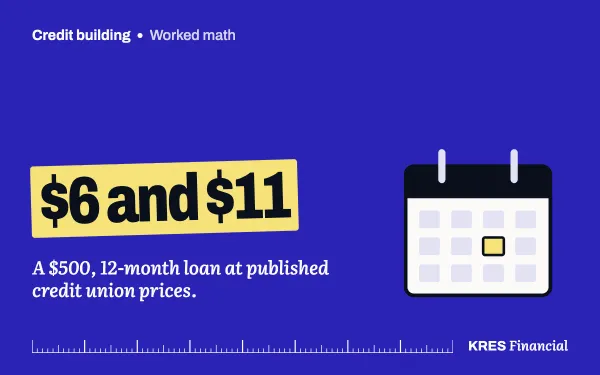
The real cost of a credit builder loan is everything you pay in, minus what you get back at the end, plus any fees charged outside the loan. On published credit union prices read November 11, 2026, a $500, 12-month loan cost between about $6 and $11; a monthly fee or a higher APR can multiply that several times.
Key takeaways
- The real cost of a credit builder loan is everything you pay in, minus what you get back at the end, plus any fees charged outside the loan.
- On published credit union prices read November 11, 2026, a $500, 12-month loan cost between about $6 and $11; a monthly fee or a higher APR can multiply that several times.
On this page
Research method: Desk research. We read published sources; we did not use or test a product.
This page shows the math so any offer can be priced the same way.
The formula
Cost = total of payments + other fees − amount released to you at the end
Three numbers on the loan's disclosure make this easy. Federal Truth in Lending rules require a lender making this kind of loan to show: [1]
- the "finance charge," described in the rule as "the dollar amount the credit will cost you";
- the "annual percentage rate," described as "the cost of your credit as a yearly rate";
- the "total of payments," described as "the amount you will have paid when you have made all scheduled payments."
If a product also charges something that is not part of the loan (for example, a membership or subscription billed separately), add it on top. The disclosure for the loan may not include it.
Worked example, using published prices
Scroll sideways to read all columns if the table is wider than your screen.
| Lender (rate effective date) | Loan | Term | APR | Monthly payment | Total of payments | Cost |
|---|---|---|---|---|---|---|
| PNCU (January 13, 2026) | $500 | 12 months | 2.25% | $42.18 | $506.16 | $6.16 |
| Secured Advantage FCU | $500 | up to 12 months | 4.00% | about $42.57 | about $510.84 | about $10.84 |
| Lighthouse Credit Union | $1,000 | 24 months | 7.69% | $46.80 in its example, with optional debt protection | $1,123.20 | $123.20 with debt protection; about $82 without |
Sorted by cost, lowest first. Sources: [2] [3] [4]. PNCU's payment and Lighthouse's example payment are the lenders' own figures. The Secured Advantage payment, all totals, and the Lighthouse figure without debt protection are our arithmetic for a standard fixed-payment loan at the stated APR.
The same loan at other rates
To show how quickly the price moves, here is a $500 loan over 12 months at the rates above and at two higher sample rates. The 12% and 16% rows are illustrations of the math, not quotes from any lender.
Scroll sideways to read all columns if the table is wider than your screen.
| APR | Monthly payment | Cost over 12 months |
|---|---|---|
| 2.25% | $42.18 | $6.16 |
| 4.00% | $42.57 | $10.84 |
| 7.69% | $43.42 | $21.04 |
| 12% (sample) | $44.42 | $33.04 |
| 16% (sample) | $45.37 | $44.44 |
Our arithmetic, standard fixed-payment loan, payments rounded to the cent.
How fees change the picture
A fee is a cost whether or not it is called interest. Two quick rules:
- A monthly fee of $X costs $12X a year. A $5 monthly charge, for example, is $60 over 12 months, roughly ten times the PNCU loan's entire cost.
- A one-time fee counts in full, even if it is small, because the loan itself is small. On a $500 loan, a $10 fee is 2% of the amount before any interest.
This is why the dollar figure matters more than the label. Two offers with the same APR can have very different totals once fees are added.
The cost that is not on the disclosure
For the whole term, your monthly payment is money you cannot use. The CFPB describes the borrowed money as "held for you as savings" until the end. [6] On the $500, 12-month examples above, that is about $42 a month going somewhere you cannot reach.
That matters most for someone who might need the cash mid-term. The CFPB's own study suggested that some borrowers "had difficulty incorporating CBL payments into existing payment obligations." [5] A late payment on another bill can cost more, in fees and in credit history, than the whole loan.
Cost per month of history
One more way to read the table: divide the cost by the number of on-time payments it buys.
- PNCU: $6.16 over 12 payments is about 51 cents a month. [2]
- Secured Advantage: about $10.84 over 12 payments is about 90 cents a month. [3]
- Lighthouse with debt protection: $123.20 over 24 payments is about $5.13 a month. [4]
Our arithmetic. Comparing offers this way puts a 12-month loan and a 24-month loan on the same footing.
Reading the worked examples
The table above compares the total paid and the cost of each example. The formula below shows how to calculate a monthly payment and total cost from an amount, term, APR, and fees.
Formula used: monthly payment = amount × r ÷ (1 − (1 + r)^−n), where r is the APR divided by 12 and n is the number of months. Cost = (payment × n) + fees − amount. Data date: November 11, 2026.
Who this fits
- Anyone comparing two or more credit builder offers.
- Anyone looking at an app-based offer whose price is described as a fee or membership rather than interest.
Who should skip this
- Anyone who cannot get the disclosure before signing. Without the finance charge and total of payments, there is no way to price it. [1]
- Anyone already paying more than the history is worth. If an on-time account already exists, even a cheap loan may buy little.
Related reading
Sources
- 12 CFR 1026.18, Content of disclosures (Regulation Z). Electronic Code of Federal Regulations. Read November 11, 2026.
- Credit Builder Loan rate page (APR effective January 13, 2026). PNCU (credit union). Read November 11, 2026.
- Secured Advantage Starter Loans. Secured Advantage Federal Credit Union. Read November 11, 2026.
- Credit Builder Loans. Lighthouse Credit Union. Read November 11, 2026.
- CFPB Study Shows Financial Product Could Help Consumers Build Credit (July 13, 2020). Consumer Financial Protection Bureau. Read November 11, 2026.
- What are some ways to start or rebuild a good credit history?. Consumer Financial Protection Bureau. Read November 11, 2026.
Change log
- : First version, with worked examples and source checks.
Educational information only. Not financial, insurance, legal, or tax advice. Read our editorial policy.
Related guides
Are Credit Builder Loans Worth It? The Cost, and Who Gains
A year of a credit builder loan can cost under $11 or far more. Who the research says gains, who loses, and three cases where it is not worth it.
How to Build Credit Without a Credit Card: What Counts and What Doesn't
Rent reporting, credit builder loans, and authorized user status can help build credit. Compare costs, limits, and what does not count.
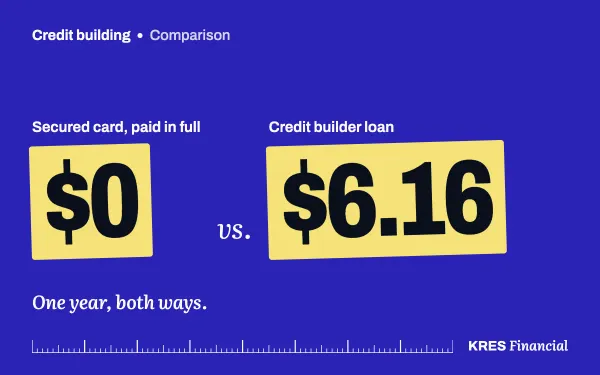
Credit Builder Loan vs. Secured Card: The Same Year, Both Ways
One year with a credit builder loan and one with a secured card, with real fees, locked money, and what a missed payment does. Sourced and dated.