Are Credit Builder Loans Worth It? The Cost, and Who Gains
A year of a credit builder loan can cost under $11 or far more. Who the research says gains, who loses, and three cases where it is not worth it.
How we are paidThis page has no paid links. Kres Financial may earn commissions on other pages when a reader uses a paid link. How we make money.
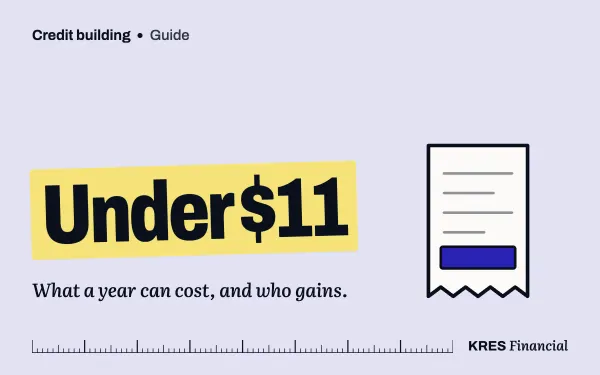
The short answer
A credit builder loan can be worth it for someone with no credit history and no other debt who can make every payment on time; a CFPB study found that group gained the most. For someone already carrying loans, or who might pay late, the same study found it can lower scores, so the cost can buy a worse result.
Key takeaways
- A credit builder loan can be worth it for someone with no credit history and no other debt who can make every payment on time; a CFPB study found that group gained the most.
- For someone already carrying loans, or who might pay late, the same study found it can lower scores, so the cost can buy a worse result.
On this page
Research method: Desk research. We read published sources; we did not use or test a product.
"Worth it" has two parts: what it costs, and what it is likely to do. Both are below, with numbers.
Part one: what a year costs
The cost is the interest and fees you pay to borrow money you do not get to use until the end. Here is the range on published credit union prices, read November 11, 2026:
Scroll sideways to read all columns if the table is wider than your screen.
| Example | Loan | Term | APR | Cost over the term |
|---|---|---|---|---|
| PNCU | $500 | 12 months | 2.25% | $6.16 |
| Secured Advantage FCU | $500 | 12 months | 4.00% | about $10.84 |
| Lighthouse Credit Union | $1,000 | 24 months | 7.69% | about $82 (about $123 with the optional debt protection in its example) |
Sorted by cost, lowest first. Sources: [3] [4] [5]. PNCU's cost uses its published $42.18 payment. The other figures are our arithmetic for a standard fixed-payment loan at the stated APR.
Other lenders charge more or less, and some charge fees on top of interest. The way to compare any offer is the federal Truth in Lending disclosure, which must show the "finance charge" (the rule's description: "the dollar amount the credit will cost you"), the "annual percentage rate," and the "total of payments." [6] Subtract the loan amount from the total of payments, add any fees not included, and that is the price of the year.
There is a second cost that does not show up on a disclosure: the monthly payment is money you cannot use for anything else until the loan ends. On a $500, 12-month loan, that is about $42 a month. [3]
Part two: what it is likely to do
The strongest public evidence is a randomized study the Consumer Financial Protection Bureau (CFPB) funded and published in 2020, following 1,531 credit union members. [1] The results split sharply by who the borrower was.
People with no existing debt gained. For participants without an existing loan, opening a credit builder loan increased their likelihood of having a credit score by 24%. Participants without existing debt saw their scores increase by 60 points more than participants with existing debt. [1]
People with existing debt could lose ground. The CFPB said the loan "appeared to cause a decrease in scores for participants with existing debt," and that on average, "those with existing loans saw their scores decrease slightly." [1] The report also found the loan was associated with more late payments on borrowers' other loans. [2]
Late payments were common. 39% of participants who opened a credit builder loan made at least one late payment on it. [2]
Why the split? Payment history makes up 35% of a FICO score, the largest single factor. [9] A new loan adds a new monthly payment. If that payment goes in on time every month, it adds positive history. If it crowds out another payment, or is itself late, it adds negative history, which credit bureaus can generally report "for up to seven years." [7]
The study has limits. It covered one product at credit unions, with enrollment in 2014 and 2015, and 62% of participants had household income under $30,000. [1] It does not predict any one person's result, and nobody can say in advance how many points a given loan will add.
So, is it worth it?
Put the two parts together:
- Probably worth considering: no credit file or a thin one, no other loans, steady income, and a payment that fits with room to spare. A year at a credit union can cost less than $11. [3] [4]
- Probably not worth it: existing loans that are hard to keep up with, an income that swings month to month, or a payment that would be a stretch. Here the research points to a real chance of ending up worse off. [1]
- Depends on price: at a few dollars a year, the cost question mostly disappears and only the risk question is left. At a much higher price, compare the total of payments against the free and cheaper options below before deciding.
Free things that come first
None of these require taking on a new payment:
- Check all three credit reports. The Federal Trade Commission says the three nationwide bureaus have "permanently extended a program that lets you check your credit report from each once a week for free at AnnualCreditReport.com," and that it is the only site authorized to fill orders for the free reports. [8]
- Dispute errors yourself. The CFPB is direct about this: no one can remove accurate negative information, and errors can be disputed "on your own at no cost." [7] Paying a company to do this is not necessary.
- Get current on anything past due. The CFPB study's results suggest a new loan does the most harm when other payments are already a struggle. [1]
Who this fits
- No credit file, or a very thin one.
- No other loans, or loans that are comfortably current.
- Steady income and a payment that fits with room left over.
- Fine with not touching the money for 6 to 24 months.
Who should skip this
- Anyone already behind, or close to it, on other loans. The study found scores fell on average for borrowers with existing debt. [1]
- Anyone who already has an open account with on-time history. The product mainly buys a record of on-time payments. If one exists, the price may buy very little.
- Anyone whose real problem is an error on a report. That can be disputed for free. [7]
Related reading
Sources
- CFPB Study Shows Financial Product Could Help Consumers Build Credit (July 13, 2020). Consumer Financial Protection Bureau. Read November 11, 2026.
- Targeting Credit Builder Loans: Insights from a Credit Builder Loan Evaluation (July 2020). Consumer Financial Protection Bureau. Read November 11, 2026.
- Credit Builder Loan rate page (APR effective January 13, 2026). PNCU (credit union). Read November 11, 2026.
- Secured Advantage Starter Loans. Secured Advantage Federal Credit Union. Read November 11, 2026.
- Credit Builder Loans. Lighthouse Credit Union. Read November 11, 2026.
- 12 CFR 1026.18, Content of disclosures (Regulation Z). Electronic Code of Federal Regulations. Read November 11, 2026.
- How long does information stay on my credit report?. Consumer Financial Protection Bureau. Read November 11, 2026.
- Free Credit Reports (June 2026). Federal Trade Commission. Read November 11, 2026.
- What's in my FICO Scores?. myFICO (Fair Isaac Corporation). Read November 11, 2026.
Change log
- : First version. Facts checked against the sources listed.
Educational information only. Not financial, insurance, legal, or tax advice. Read our editorial policy.
Related guides
How to Build Credit Without a Credit Card: What Counts and What Doesn't
Rent reporting, credit builder loans, and authorized user status can help build credit. Compare costs, limits, and what does not count.
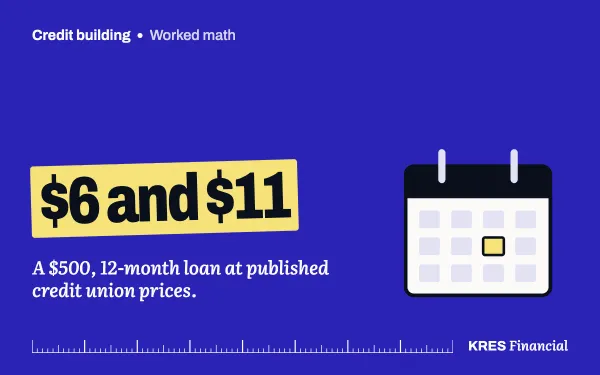
What a Credit Builder Loan Really Costs: The Math, Line by Line
How to turn any credit builder offer into one dollar figure: total of payments, fees, and locked money. With a worked table at real and sample rates.
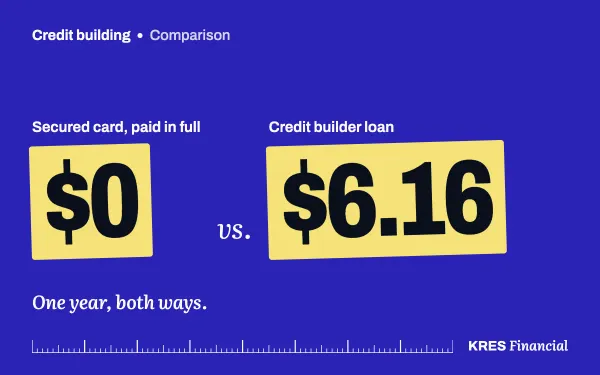
Credit Builder Loan vs. Secured Card: The Same Year, Both Ways
One year with a credit builder loan and one with a secured card, with real fees, locked money, and what a missed payment does. Sourced and dated.