How to Build Credit Without a Credit Card: What Counts and What Doesn't
Rent reporting, credit builder loans, and authorized user status can help build credit. Compare costs, limits, and what does not count.
How we are paidThis page has no paid links. Kres Financial may earn commissions on other pages when a reader uses a paid link. How we make money.
The short answer
Credit history comes from accounts that report payments to the credit bureaus, and several are not credit cards: rent reported through a landlord's reporting program, a credit builder loan, and, with limits, being an authorized user on someone else's card. Debit cards, prepaid cards, and payday loans generally do not build credit, according to the CFPB.
On this page
Research method: Desk research. We read published sources; we did not use or test a product.
The principle behind all of it: a credit score is built from what is on your credit reports, and "creditors are not required to report to every credit reporting company," as the Consumer Financial Protection Bureau (CFPB) puts it. [9] So the question to ask about any payment is not "is this a bill I pay on time?" It is "does this company report it, and to which bureaus?"
Options that can build credit without a card of your own
- 1. Rent, if it is reported
- 2. A credit builder loan
- 3. Authorized user on someone else's card
- 4. A secured card (yes, a card, but a different kind)
The options at a glance
| Option | Cost | New debt | Catch |
|---|---|---|---|
| 1. Rent, if it is reported | Cost: $0 if the landlord already reports. Third-party reporting services may charge a fee. | New debt: none. | Catch: late rent can be reported too. The same CFPB answer begins its explanation of late rent with "Yes." [2] |
| 2. A credit builder loan | Cost: one credit union's published example is $500 over 12 months at 2.25% APR, with a $42.18 monthly payment, which works out to $6.16 in total cost by our arithmetic. [6] Other lenders charge more. | New debt: yes, a fixed monthly payment. | Catch: in a CFPB study, borrowers who already had other debt saw their scores fall slightly on average, while borrowers without existing debt did much better. [5] Full detail is in what a credit builder loan is. |
| 3. Authorized user on someone else's card | Cost: $0, usually. | New debt: none for you. | Catch: you inherit the owner's habits. Ask the card issuer whether it reports authorized users before counting on it. [4] |
Listed from no new debt to new debt.
1. Rent, if it is reported
The CFPB says the three nationwide bureaus, Experian, Equifax, and TransUnion, "use rental payment and related debt collection information in their credit reports, although the way they handle this information varies," and that "positive rental payments can help build your credit." [2]
Rent is not reported automatically. The CFPB's suggestion is to "ask your landlord if they participate in a rental reporting program (often through a rental payment app)," and to "consider any fees that might be charged for these services." [2]
- Cost: $0 if the landlord already reports. Third-party reporting services may charge a fee.
- New debt: none.
- Catch: late rent can be reported too. The same CFPB answer begins its explanation of late rent with "Yes." [2]
2. A credit builder loan
A small loan where the lender holds the money in savings while you repay it, then releases it at the end. The CFPB describes payments "usually over six to 24 months." [1]
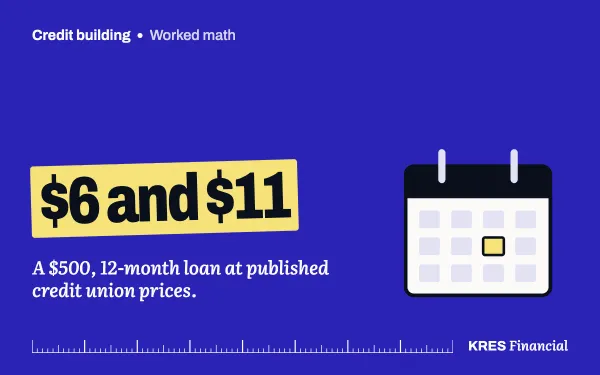
- Cost: one credit union's published example is $500 over 12 months at 2.25% APR, with a $42.18 monthly payment, which works out to $6.16 in total cost by our arithmetic. [6] Other lenders charge more.
- New debt: yes, a fixed monthly payment.
- Catch: in a CFPB study, borrowers who already had other debt saw their scores fall slightly on average, while borrowers without existing debt did much better. [5] Full detail is in what a credit builder loan is.
3. Authorized user on someone else's card
A family member or partner adds you to their card account. This uses a credit card, but not one in your name or one you are legally responsible for.
The CFPB's teaching guide lays out the tradeoffs. The account owner, not the authorized user, is "legally responsible for those purchases." If either person runs up "excessive credit card charges or miss[es] payments on the card, it could hurt the other's credit score, too." And it "won't necessarily help" the authorized user build history, because "not all banks and card issuers provide authorized users' card payments to the credit reporting bureaus." [4]
- Cost: $0, usually.
- New debt: none for you.
- Catch: you inherit the owner's habits. Ask the card issuer whether it reports authorized users before counting on it. [4]
4. A secured card (yes, a card, but a different kind)
For completeness: if the worry is debt rather than plastic, a secured card works off a deposit you put down. The CFPB's example: "You put in an amount of cash, for example $500. Then, you can spend up to that amount." [1] We compare it with a credit builder loan, in dollars, in credit builder loan vs. secured card.
What usually does not build credit
The CFPB lists payments that "typically" are not reported to the nationwide bureaus: [1]
- Debit cards and cash. "You are not borrowing money that you need to repay later."
- Prepaid cards. They "do not help you establish your credit history."
- Payday loans. "Even if you make on-time payments, a payday loan does not help your credit history."
- "Buy here, pay here" car loans. These dealers "often report only negative information."
Utility and phone bills are mixed. The CFPB says "most utility companies don't provide consumer payment history data to the big three credit reporting companies," but an unpaid bill sent to collections "could show up on your credit reports." [3] In other words, these bills often cannot help, but they can hurt.
Why on-time payments matter most
Payment history is 35% of a FICO score, the largest of its five factors. [7] Every option above works only if the payments are on time, and every one of them can report a late payment as easily as an on-time one.
A free first step
Before adding anything, it costs nothing to see what is already there. The Federal Trade Commission says all three bureaus offer a free report from each "once a week" at AnnualCreditReport.com, the only site authorized for the free reports. [8]
Who this fits
- People new to credit, or rebuilding, who would rather not open a credit card.
- Renters whose landlord already reports, or offers reporting.
- People with a trusted family member who has a long, on-time card history.
Who should skip this
- Skip paid rent reporting if the landlord already reports, or the fee is more than the history is worth right now. [2]
- Skip a credit builder loan if the payment would make another bill late. [5]
- Skip authorized user status if the card's owner carries high balances or misses payments. Their history becomes part of yours. [4]
Related reading
Sources
- What are some ways to start or rebuild a good credit history?. Consumer Financial Protection Bureau. Read November 11, 2026.
- Does late rent affect my credit score?. Consumer Financial Protection Bureau. Read November 11, 2026.
- Does my history of paying utility bills, like telephone, cable, electricity, or water, go in my credit report?. Consumer Financial Protection Bureau. Read November 11, 2026.
- Building Blocks teacher guide: Cosigning loans and sharing credit (Summer 2022). Consumer Financial Protection Bureau. Read November 11, 2026.
- CFPB Study Shows Financial Product Could Help Consumers Build Credit (July 13, 2020). Consumer Financial Protection Bureau. Read November 11, 2026.
- Credit Builder Loan rate page (APR effective January 13, 2026). PNCU (credit union). Read November 11, 2026.
- What's in my FICO Scores?. myFICO (Fair Isaac Corporation). Read November 11, 2026.
- Free Credit Reports (June 2026). Federal Trade Commission. Read November 11, 2026.
- What is a credit report?. Consumer Financial Protection Bureau. Read November 11, 2026.
Change log
- : First version. Facts checked against the sources listed.
Educational information only. Not financial, insurance, legal, or tax advice. Read our editorial policy.
Related guides
Are Credit Builder Loans Worth It? The Cost, and Who Gains
A year of a credit builder loan can cost under $11 or far more. Who the research says gains, who loses, and three cases where it is not worth it.
What a Credit Builder Loan Really Costs: The Math, Line by Line
How to turn any credit builder offer into one dollar figure: total of payments, fees, and locked money. With a worked table at real and sample rates.
Credit Builder Loan vs. Secured Card: The Same Year, Both Ways
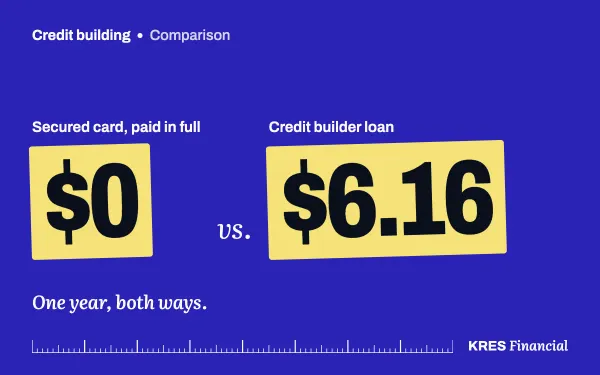
One year with a credit builder loan and one with a secured card, with real fees, locked money, and what a missed payment does. Sourced and dated.