Car Insurance Quotes Without Phone Calls: How Lead Selling Works
Why one quote form can lead to a flood of calls, what the consent checkbox actually allows, and the ways to shop that keep your phone quiet.
How we are paidThis page has no paid links. Kres Financial may earn commissions on other pages when a reader uses a paid link. How we make money.
The short answer
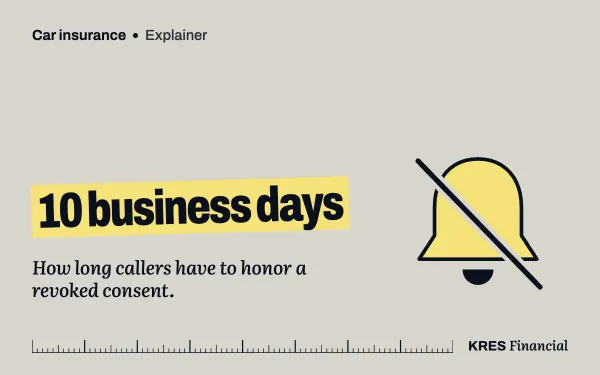
The calls usually come from the consent you give on a quote form: many comparison sites sell your details as a 'lead' to several insurers or agents, and checking the consent box allows them to call and text. Getting a quote directly from one insurer, or not checking an optional consent box, limits who has your number; once you are being called, you can revoke consent in any reasonable way, and callers must honor it within 10 business days.
Key takeaways
- The calls usually come from the consent you give on a quote form: many comparison sites sell your details as a 'lead' to several insurers or agents, and checking the consent box allows them to call and text.
On this page
Research method: Desk research. We read published sources; we did not use or test a product.
The calls usually come from the consent you give on a quote form: many comparison sites sell your details as a "lead" to several insurers or agents, and checking the consent box allows them to call and text. Getting a quote directly from one insurer, or not checking an optional consent box, limits who has your number; once you are being called, you can revoke consent in any reasonable way, and callers must honor it within 10 business days.
This page explains the machinery, because once you can see it, it is easier to decide which forms to fill in.
How a quote form turns into phone calls
The clearest description we found is in a federal appeals court opinion from January 2025, in a case brought by an insurance marketing trade group. The court described the business this way: [1]
- "Lead generation ... is the process of identifying and cultivating individual consumers ... potentially interested in purchasing a product or service."
- "Identified consumers and their contact information are known as 'leads.' The companies that do the collecting are known as 'lead generators.'"
- "Lead generators often sell leads to the 'end-buyer merchants' that sell the product," and "also often sell the leads to 'lead aggregators,'" which resell them again.
And on comparison sites specifically: "Consumers visit the comparison-shopping website and enter information about themselves and the product they want to purchase. The consumers consent to be contacted by the website's partners and affiliates." The site then "matches" the consumer with companies and "sells the 'leads' ... to the matched affiliates so that the affiliates can robocall or robotext the consumers with offers, quotes, or some other message." [1]
That is how one form can turn into many calls. You filled in one form, and the form's owner can sell your details to several buyers, each of whom then contacts you separately.
What the consent checkbox allows
Federal rules under the Telephone Consumer Protection Act require "prior express written consent" before a company uses an autodialer or a prerecorded voice for telemarketing. The rule defines it as a signed written agreement (an electronic signature counts) that "clearly authorizes the seller" to send those calls or texts to a specific number. [2]
Two details in that rule matter to anyone filling in a form:
- The form must say consent is optional. The agreement has to include a "clear and conspicuous disclosure" that the person "is not required to sign the agreement ... as a condition of purchasing any property, goods, or services." [2] If a box is labeled as consent to calls, the rule says you cannot be required to check it to buy.
- One box can still cover many companies. In 2023, the Federal Communications Commission adopted a rule that would have limited consent to one seller at a time: a consumer could not consent with a single checkbox covering "Bank A and Bank B," let alone a list of thousands of "marketing partners." The court vacated that part of the rule in January 2025, holding that the FCC "exceeded its statutory authority." [1] The current rule text we read on November 11, 2026, does not contain that one-seller limit. [2]
Does the Do Not Call Registry stop these calls?
Often not. The Federal Trade Commission says: "Companies can call you if you've recently done business with them, or if you've given them written permission to call." [3] A checked consent box on a quote form is that written permission. The FTC also notes the Registry "doesn't block calls"; it tells law-following telemarketers which numbers not to call. [3]
How to stop calls once they start
The FCC's rules give you a strong tool here. A person "may revoke prior express consent ... by using any reasonable method to clearly express a desire not to receive further calls or text messages." [2] The rule says specific methods count automatically, including replying "stop," "quit," "end," "revoke," "opt out," "cancel," or "unsubscribe" to a text, or using an opt-out option on the call. [2]
Callers "may not designate an exclusive means" of revoking, and revocation "must be honored within a reasonable time not to exceed ten business days." [2]
Revocation works per caller. If your details went to five companies, each one needs to hear it. Keeping a short list (company, date, how you told them) makes any later complaint easier to support.
Ways to shop that limit who gets your number
None of these is a promise of zero calls, because each company decides how it follows up. Each one limits how many companies have your number.
- Quote directly with one insurer at a time. Your details go to that insurer, not to a marketplace of buyers. You may still hear from that insurer.
- Read the consent language before you submit. Look for a separate, optional checkbox, and for a link to a list of "partners." Under the federal rule, consent to autodialed or prerecorded marketing calls cannot be a condition of buying. [2]
- Use an insurance agent you contact yourself. You choose who has your number.
- Use your state regulator's tools. State insurance departments publish consumer guides. Texas, for example, points drivers to its HelpInsure.com site and publishes a shopping worksheet. [5]
One reassurance while you shop: getting quotes does not lower your credit score. Insurers that check credit for a quote use a soft inquiry, which Experian says "doesn't affect your credit scores." [4] More on that in does a quote affect your credit.
Where this site fits
We think a page like this should say how its own publisher makes money. Kres Financial earns a commission when a reader signs up with certain companies through links on our pages. This page has no paid links. When an insurance comparison partner is approved for our site, any page that links to it will say so directly under the headline, and the link itself will carry a "Paid link" label, the kind of plain label the Federal Trade Commission's endorsement guidance discusses for affiliate links. [6]
We do not collect your phone number or ask you to fill in a quote form here. If a partner's form collects your details, that partner's consent language governs what happens next, and the points above apply to it. Full detail: how we make money.
Who this fits
- Anyone who wants to compare car insurance prices without a wave of calls and texts.
- Anyone already getting calls after a quote and looking for the rule that makes them stop.
Who should skip this
- People who want phone help. If you would like several agents to call and walk you through options, a lead form may be the fastest route, and this page's tradeoffs do not apply.
- People who only want the credit answer. See does a quote affect your credit.
Related reading
Sources
- Insurance Marketing Coalition Ltd. v. FCC, No. 24-10277 (11th Cir., filed January 24, 2025). U.S. Court of Appeals for the Eleventh Circuit. Read November 11, 2026.
- 47 CFR 64.1200, Delivery restrictions (Telephone Consumer Protection Act rules). Electronic Code of Federal Regulations. Read November 11, 2026.
- National Do Not Call Registry FAQs (September 2023). Federal Trade Commission. Read November 11, 2026.
- Do Car Insurance Quotes Affect Your Credit Score? (March 19, 2025). Experian. Read November 11, 2026.
- Auto insurance guide (last updated December 11, 2025). Texas Department of Insurance. Read November 11, 2026.
- FTC's Endorsement Guides: What People Are Asking. Federal Trade Commission. Read November 11, 2026.
Change log
- : First version. Facts checked against the sources listed.
Educational information only. Not financial, insurance, legal, or tax advice. Read our editorial policy.
Related guides
Does Getting a Car Insurance Quote Affect Your Credit Score?
No. Insurers that check credit for a quote use a soft inquiry, which does not change your credit score. What they look at, and where they can't.
How to Shop for Car Insurance: A Plain Guide to Comparing Quotes
Start here. What to have ready, what each coverage pays for, how to compare quotes like for like, and when it is worth shopping. Sourced and dated.
Can You Switch Car Insurance in the Middle of a Policy?
Yes. You do not have to wait for renewal. How the refund works, how to avoid a gap in coverage, and what a car loan changes, with a worked example.